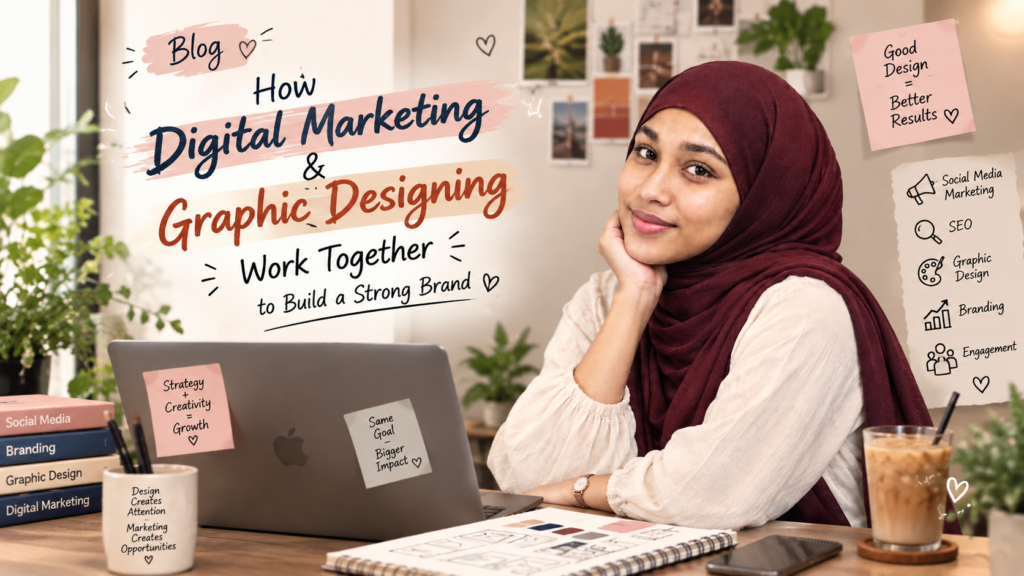
Today, people see hundreds of advertisements, social media posts, videos, websites, and brand messages every day. With so much content around us, businesses have only a few seconds to catch someone’s attention.
This is where digital marketing and graphic design come together.
Digital marketing helps a business reach the right people online, while graphic design helps communicate the message in a way that people can understand, remember, and connect with.
A good advertisement with poor design may be ignored. On the other hand, a beautiful design without a clear marketing message may look attractive but fail to bring results.
So, digital marketing and graphic design are not completely separate. They work together to create a strong online presence.
What Is Digital Marketing?
Digital marketing is the process of promoting a business, product, service, or personal brand using digital platforms.
Some common areas of digital marketing include:
- Social media marketing
- Search Engine Optimization (SEO)
- Content marketing
- Email marketing
- Google Ads
- Social media advertising
- Influencer marketing
- Website marketing
- Video marketing
For example, imagine a small clothing brand wants to attract new customers.
The business can use Instagram to share posts and reels, Google to help people discover its website, advertisements to reach potential customers, and email marketing to stay connected with existing customers.
But all of these marketing activities need something important: visual communication.
This is where graphic design becomes valuable.
What Is Graphic Design?
Graphic design is the process of communicating ideas and messages through visual elements.
It can include:
- Typography
- Colors
- Images
- Illustrations
- Layouts
- Icons
- Logos
- Posters
- Social media designs
- Brochures
- Website graphics
- Advertisements
Graphic design is not simply about making something look beautiful.
A good design should have a purpose.
It should help people understand the message, recognize the brand, and know what action they should take.
For example, a social media advertisement might use a strong headline, an attractive image, brand colors, and a clear call-to-action such as “Shop Now” or “Learn More.”
Every element has a role.
Why Is Graphic Design Important in Digital Marketing?
Imagine scrolling through Instagram.
You see a post with too many words, random colors, poor-quality images, and confusing information. You probably scroll past it.
Then you see another post with a clean layout, attractive colors, a simple message, and an interesting image.
You may stop and read it.
That small moment shows why graphic design matters.
Good design can help a business:
- Get attention
- Communicate information clearly
- Build brand recognition
- Create a professional appearance
- Improve engagement
- Make content memorable
- Encourage people to take action
However, design should support marketing goals rather than simply trying to look impressive.
1. First Impressions Matter
People often form an initial impression of a brand based on what they see.
A website, Instagram profile, advertisement, or poster may be someone’s first interaction with a business.
If the visual presentation looks professional and consistent, it can create a positive first impression.
For example, imagine two digital marketing agencies.
The first agency has a website with consistent colors, clear typography, professional images, and organized content.
The second agency has different fonts on every page, random colors, blurry images, and confusing layouts.
Even if both agencies offer similar services, their visual presentation may influence how people perceive them.
This is why graphic design is an important part of building a professional digital presence.
2. Branding Creates Recognition
Have you ever recognized a company just by seeing its colors, logo, or design style?
That is the power of branding.
A strong brand usually maintains consistency across different platforms.
For example, a business may use the same:
- Logo
- Color palette
- Fonts
- Image style
- Design elements
- Tone of communication
When these elements are used consistently, people can begin to recognize the brand more easily.
For a small business, this can be especially useful because consistent branding helps create a more professional and memorable identity.
3. Social Media Needs Strong Visuals
Social media is one of the biggest areas where digital marketing and graphic design meet.
Instagram posts, stories, reels, YouTube thumbnails, LinkedIn posts, and advertisements all depend heavily on visual communication.
A social media designer needs to think about more than just colors and images.
They need to ask:
Who is going to see this?
What should they understand first?
What should they feel?
What action should they take?
For example, if a restaurant wants to promote a special offer, the design should make the food look appealing while making the offer easy to understand.
If the audience needs to search for the important information, the design is not doing its job effectively.
4. Good Design Makes Content Easier to Understand
Not everyone wants to read a long paragraph.
Sometimes, a complicated idea can be communicated more effectively through a simple visual.
Infographics are a good example.
Suppose a digital marketing agency wants to explain five SEO tips.
Instead of writing five large paragraphs, the agency could create an infographic with five simple sections.
This makes the information easier to scan and understand.
Graphic design can turn complicated information into something more visually organized.
5. Typography Can Change the Message
Typography is another important part of graphic design.
The font you choose can influence how a message feels.
A bold font can create a strong and confident appearance.
A simple sans-serif font can feel clean and modern.
A handwritten font can create a more personal feeling.
But using too many fonts can make a design confusing.
A simple design often works better with one or two complementary fonts.
Typography should also be readable, especially on mobile devices.
There is no point in choosing a beautiful font if people cannot easily read the message.
6. Colors Can Support Brand Communication
Colors are another important part of design.
Different colors can create different visual feelings and associations.
For example, blue is often used by brands that want to communicate trust and professionalism, while orange can create a more energetic and friendly feeling.
However, color choices should also depend on the brand, audience, industry, and overall design style.
The goal is not to follow color trends blindly.
Instead, businesses should choose colors that support their identity and maintain consistency across their marketing materials.
7. Graphic Design Supports Advertising
Digital advertising is another area where design plays an important role.
Whether it is a Facebook advertisement, Instagram campaign, Google display ad, or promotional banner, the visual needs to communicate quickly.
A good advertisement usually has:
A clear message + Strong visual + Relevant offer + Call-to-action
For example:
“Grow Your Business Online”
followed by a short supporting message and a button such as:
“Get Started.”
The design should guide the viewer’s attention toward the most important information.
If everything on the advertisement is large, colorful, and bold, nothing feels important.
Good design creates visual hierarchy.
8. Websites Need Both Marketing and Design
A website is more than just a collection of attractive pages.
It needs to be designed around the user’s experience.
A good website should make it easy for visitors to:
- Understand what the business offers
- Find important information
- Explore services
- View products or projects
- Read testimonials
- Contact the business
- Take the desired action
Graphic design helps create the visual experience, while digital marketing helps bring visitors to the website.
For example, SEO can help people discover a website through Google, while good design can help them stay on the website and understand the business.
This shows how both fields support each other.
9. Content and Design Should Work Together
Content tells people what you want to say.
Design helps determine how people experience that message.
Imagine a beautifully designed Instagram post with an unclear message.
It may get attention but fail to communicate.
Now imagine a very useful piece of content with poor formatting.
People may not spend enough time reading it.
The best results often happen when content and design are planned together.
A marketer can decide the target audience and marketing goal, while a designer can turn the message into a visual format that is easy to understand.
10. AI Is Changing Digital Marketing and Design
Artificial intelligence is becoming an important part of both digital marketing and graphic design.
AI tools can help marketers brainstorm ideas, analyze information, generate content concepts, and automate certain tasks.
Designers can also use AI for inspiration, image creation, editing, and faster experimentation.
But AI does not remove the need for human creativity.
A tool can generate an image, but a person still needs to understand whether the image fits the brand, audience, message, and marketing objective.
Human understanding remains important.
The future is likely to involve people using technology as a tool rather than depending on it completely.
Common Mistakes to Avoid
There are a few mistakes businesses should avoid when combining digital marketing and graphic design.
Using Too Much Information
Trying to put everything into one design can make it difficult to understand.
Keep the main message clear.
Using Too Many Fonts
Multiple fonts can make a design look unorganized.
Choose a small number of fonts and use them consistently.
Ignoring Mobile Users
Most people consume digital content on smartphones.
Always make sure designs are readable on smaller screens.
Copying Trends Without Understanding the Brand
Trends can be useful, but every trend does not suit every business.
A design should still feel connected to the brand.
Designing Without a Goal
Before creating a design, ask what you want the audience to do.
Do you want them to visit your website?
Send a message?
Buy a product?
Read an article?
The answer should influence the design.
The Future of Digital Marketing and Graphic Design
Digital marketing and graphic design are becoming increasingly connected.
Brands are competing not only for customers but also for attention.
People expect content to be quick, visually appealing, useful, and easy to understand.
This means marketers and designers need to understand each other’s work.
A graphic designer who understands marketing can create designs with stronger purpose.
A digital marketer who understands design can communicate ideas more effectively.
Together, they can create content that is both attractive and meaningful.
Final Thoughts
Digital marketing brings a brand’s message to people, while graphic design helps that message stand out and communicate clearly.
Neither one is only about getting attention.
The real goal is to connect with people.
A good design should make someone stop scrolling. A good marketing strategy should give them a reason to stay. And valuable content should give them a reason to trust the brand.
Whether you are a small business owner, freelancer, digital marketer, graphic designer, or personal brand, learning how these two fields work together can help you create a stronger online presence.
In the end, successful digital marketing is not just about having beautiful designs or posting every day.
It is about understanding people, communicating clearly, being consistent, and creating something that provides real value.
Good marketing gets attention. Good design makes people notice. But meaningful communication is what helps a brand stay remembered.